



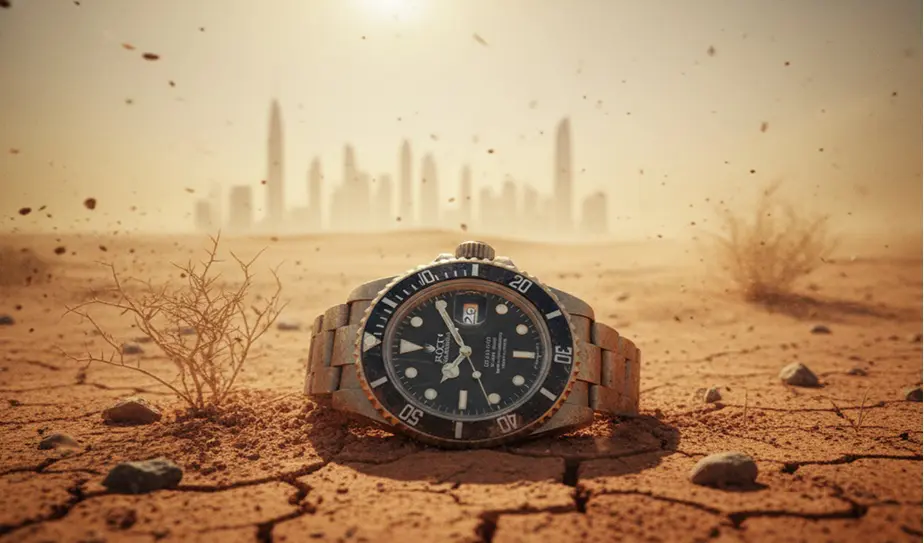
The city of Dubai evokes mental pictures of enormous glass buildings, amazing wealth, and permanent sunshine.
In a place where costly watches are sometimes virtually mandatory and definitely appreciated, visitors and residents alike show off their latest acquisitions on streets and in cafés that ooze affluence.
However there is something about his wealthy emirate that may surprise lovers of horology: Its intense summer heat!
Dubai’s Intense Summer Months
During the months of June to September, Dubai reaches extreme heat levels resembling an oven, surpassing 45°C (113°F) and high humidity resulting in a heavy atmosphere. Such warmth may be unpleasant for your mechanical or quartz watch– but it could also harm them.
While your watch may be waterproof or “shock-resistant,” heat, humidity, and sudden changes in temperature can damage its delicate inner workings– and even affect how it looks. To make sure your favorite timepiece gets through the Dubai summer without any problems, you’ll need to take good care of it!
1. The Enemy Within: Heat and Lubricants
At the center of an exceptional mechanical watch lies an intricate movement— a real spectacle! This is a true symphony of miniature gears, springs, and levers working together.
But to perform just right over time, the components depend on special lubricants applied in super-thin layers— almost at the microscopic level!
- The Problem: Intense heat has the potential to break down lubricants. When temperatures rise, oils become thin— evaporating at a greater rate, or they may chemically degrade. This situation creates an undesirable increase in friction for components that require movement.
- The Effect: When lubricants get thin or degrade, parts wear out faster. This leads to machines becoming less precise and moving more slowly– issues that often mean expensive repairs down the line. It’s somewhat similar to running a car engine low on oil.
- The Solution: It’s advisable to avoid extended direct exposure to very high temperatures. So, when your watch isn’t adorning your wrist— and you’re not swimming while wearing it— be sure to store it somewhere cool and shaded inside your home. And for the best care? Put that special timepiece back in its box too!
2. The Silent Killer: Humidity and Condensation
It isn’t only hot in Dubai during summer but also very humid— particularly near the coast.
Such atmospheric moisture presents a major threat; even watches labelled as ‘water-resistant’ can be affected by it.
- The Problem: Okay, so even though your watch says 100 m or 200 m, it really just means it can stand still water pressure at room temp. Gaskets are tricky! They might swell or shrink with a lot of heat, which could lead to tiny (we mean microscopic) openings. And when that warm watch hits cooler air— like if you walk into an air-conditioned mall— condensation can occur. This is because the quick temperature shift makes moisture inside the case form visible fog beneath the crystal.
- The Effect: If condensation is not managed, it can cause rust on steel components and corrosion of brass or copper parts. This means that the dial, hands, and movement may be affected– damage that cannot be undone.
- The Solution:
- Check your gaskets: Perhaps your watch is due for a service or a pressure test. If it hasn’t been checked for some years now, make an appointment with a qualified watchmaker before summer arrives. Because gaskets do deteriorate as time passes!
- Avoid rapid temperature changes: Avoid exposing your luxury watch to extreme temperature changes, such as moving it from hot outdoor heat directly into a cold shower or submerging it in a chilly pool– even if the timepiece is water-resistant. Give it time to adjust slowly.
- If you see condensation: Take immediate action! It is essential to seek the assistance of a watch specialist who can skillfully open your timepiece, dry it, and perform any necessary services. Avoid attempting to dry it at home using heat– this could make matters worse.
3. Sun Exposure: Aesthetics and UV Damage
More than just the inner workings; the intense sun in Dubai may also affect how your watch looks.
- The Problem: If exposed to strong UV rays and heat for a long time, your watch may change color.
- The Effect:
- Dial Fading: Dials– particularly vintage ones or those in bright colors– can fade unevenly, making them less attractive and reducing the resale value.
- Lume Degradation: Sometimes the luminous material on hands and markers seems to lose its glow– as if it were fading more quickly.
- Strap Damage: Leather bands? They dry out, crack– becoming brittle. Rubber bands might get a sticky feel or go stiff. Even metal bracelets can feel too hot against your skin.
- The Solution:
- Leather out, Rubber in: Change your leather straps during summer to rubber, NATO, or metal ones– they’re better at dealing with sweat and heat.
- Shade is your friend: When your watch isn’t on your wrist, remember to cover it or place it in its box– away from any direct sunlight.
4. Sand and Dust: The Gritty Reality
Dubai is essentially a desert city. Even without any sandstorms, there are always tiny dust particles in the air– so small they can slip into even minuscule gaps in your watch.
- The Problem: If the gaskets in your watch aren’t doing their job, tiny particles like dust or sand may find their way inside.
- The Effect: Imagine these abrasive particles! They work just like sandpaper on the tiny parts and pivots inside a movement.
- The Solution: Remember to always keep your watch tightly sealed. For example, after being in dusty places like on desert safaris– just wipe the watch with a soft clean cloth. There’s no need for you to open the case back yourself.
The Golden Rule: Prevention and Professional Care
Ultimately, protecting your luxury watch in Dubai’s summer boils down to common sense and proactive maintenance.
- When in Doubt, Take it Off: If you’re planning an activity where you will be exposed to very high temperatures for a long time, or if you’ll sweat a lot or experience big temperature changes, it might be better to leave your watch indoors.
- Regular Servicing: Keep an eye on those suggested service dates for your watch– they’re often every 3-5 years. This helps ensure that, for instance, oil stays fresh and that seals remain pliable enough to do their job effectively.
- Listen to Your Watch: You really should see a professional watchmaker right away if you spot fog under the glass, notice the time drifting off, or see anything else odd with your watch.
The summer heat in Dubai is very challenging– even for the things its people love most! But if you’re careful and pay attention, your watch will come through looking just as good (and keeping time just as well) as when it first went in– despite the heat haze.
